For many, the use of methanol is a little disconcerting as it is derived from fosil fuels, however it is still the simplest alcohol to use for the biodiesel production process. As a means of reducing the ecological impact of methanol use some have opted to recover a portion of it via the use of a condenser and simply distill it from the glycerine by-product ect. left over after the reaction has completed.
There are many ingenious ways of building a condenser; some are attached to the reactor/processor while yet others are free-standing units, not unlike the old pot stills used in the moonshine days. Actually a pot still would make an excellent methanol recovery unit, for those with the knowledge and materials to build one.
For common people, like us, we have chosen a simpler route. A very basic, water-cooled condenser with steam entering one end and liquid coming out at the other. Our condenser can be made by anyone who has access to a hardware store where plumbing supplies are sold.
We have used a piece of black two inch water pipe as the body and a coil of soft copper as the condensing unit.

In the above photo you can see all the materials needed, other than what you attach it to, to build a no-nonsense
methanol recovery unit.
A .91m (3ft) piece of 5.08cm (2in) water drain pipe with two 7.6cm (3 inch) nipples cut from the ends. Then the nipples are fitted into end caps
and T's with a 5.08cm (2") female thread in the side port. Into these threaded side ports we screw in poly bungs from poly
drums with a center thread of 1.9cm (3/4in) already installed in the knock-out plug. Into these openings we screw in 1.9cm (3/4in)
male to hose barb fittings. Standard teflon pipe tape is used for the fittings. Be sure to use the proper type of pipe cement when
glueing the parts together. Ask the people where you get the drain pipe from which is best for your application.
Were it not for the soft copper coil we would be done, but then it wouldn't work, so on to the coil.
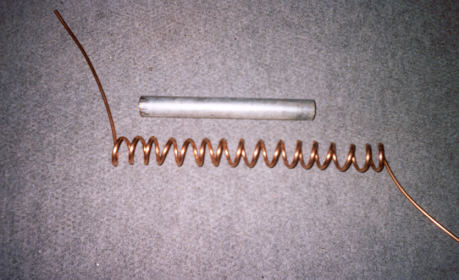
Seeing as we are using soft copper and it already comes pre-measured, we decided on a 3.04m (10ft) piece. You may think that that is way too long to fit inside that short piece of drain pipe, but think again. We took a 3.8cm (1 1/2in) diameter pipe and, leaving enough for end lengths, started slowly coiling the soft copper around the pipe until we got the result seen in the photo. Now all that has to be done is fit it inside the drain pipe and close it all up. The end caps have to have holes poked through to let the ends of the copper coil stick out. Make the holes just barely big enough for this purpose. You can actually just make small X incisions in the center and then thread the coil through it at either end which will cause the X's to bulge outward. This is good and will fascilitate the sealing of it later.
After having poked one end of the coil through the end cap and making sure that the cap is well glued to the nipple you can then gently stretch the coil out so that the other end can be poked through the other end cap. You do not leave the pipe inside the coil, by the way, it is only used to do the coiling so you don't get any kinks in the copper tubing. Now that you have the copper coil poking out both end caps, they have to be sealed so the water won't be coming out and mixing with the methanol making the whole exercise pointless.
We use an automotive adhesive product called "Goop" (click) a product made to glue metalic parts to vinyl and other pastics on a car. It is very resistant and weathers well also. Take the Goop and smear a generous portion at either end of the nearly completed condenser, making certain to get some into the cracks in the X's so that it is water tight.
Remember the 2 male to hose barb fittings ? To these we attach lengths of the hose of your choice. We prefer clear hose so we can see what is happening (or not happening). The bottom one is for filling the condenser with water, so a garden hose attachment may be handy. The top one is where the water comes out, so have it eiter return to the bucket from where you are filling it from or somewhere else you want to have water, like a garden, flower box, or in our case, to the water tank that we draw from for washing the biodiesel with. It essentially serves three purposes; one, it cools he condenser, two, it washes the biodiesel and three it then, being full of lye and methanol residue, kills weeds like the poison ivy that we have.

The complete unit, ready to be attached to whatever distilling method that is prefered. We use grabble bar to attach it to out distiller by wrapping a piece around the body of the condenser and then afixing it to the distiller. You may find a better way.
The equipment you will need:
- a piece of 5.08cm (2in) water drain pipe .91m (3ft) long.
- 2 T's with female threaded 5.08cm (2in) side ports.
- 2 5.08cm (2in) poly drum bungs.
- 2 5.08cm (2in) end caps (temporary caps are OK)
- 2 1.9cm (3/4in) male to hose barb fittings (PVC is fine)
- 2 hose clamps
- 2 lengths of hose.
- 1 3.04m (10ft) coil of asoft copper tubing.
- 1 piece of pipe 3.8cm (1 1/2in) in diameter.
- 1 garden hose adapter (optional)
- 1 tube of Goop adhesive. (Bulldog Cement MAY work ok too)
- something to attach it to where you kook it up.
For copyright please see top paragraph: B100-WH